Kids' Home Page

If you have studied about California Indians, you may have heard about the Emeryville Shellmound. Maybe you are doing some research to learn more about the site and what archaeologists found there. The questions below will lead you to more information about the site. If you are interested in more details or pictures, check out the links in the Glossary or click on linked words in the text.

Introduction to the Emeryville Shellmound

What is a shellmound?

Where people have settled, all around the world, the things that they use up, lose, or throw away become mixed with the soil and rocks on the ground. Decomposing debris, including the remains of houses, shell and bone from meals, charcoal and ash from fires, rocks from hearths, tools and other things that have been broken or lost, create new soil, which archaeologists call midden.

Over time, this material builds up into a mound. A shellmound is a pile of midden built up at a place where people ate a lot of shellfish and discarded a lot of shell. These sites are usually located on the ocean coast or the shore of a bay.

What was the Emeryville Shellmound?

Shellmound.gif

The Emeryville Shellmound was the archaeological remains of a large village site on the shore of the San Francisco Bay. Native American people lived at the site for over 2 thousand years. There were over 400 shellmounds on the shores of the bay. The Emeryville Shellmound was the largest shellmound in the Bay Area and possibly in all of California.

The mound was a steep-sided cone, with a buried base over 8 feet deep. Before it was leveled in 1924 the total height of the deposit was as much as 40 feet - as high as a 4 story building - and over 350 feet in diameter - as long as a football field.

How was the Emeryville Shellmound formed and why did it get so big?

Shellmounds and other archaeological sites are formed in layers (which archaeologists call strata) much like a layer cake. The bottom "layer" - or stratum - represents the earliest occupation of the site. Each stratum of the mound above the bottom represents a later and later period of occupation.

The Emeryville Shellmound and other similar mounds were built up over long periods of time as people discarded things at the places where they lived. Over time, the material discarded year after year formed a mound. Eventually, the mound was like a little hill on the bayshore, a landmark for the Emeryville village. This hill might have been a good place to get a view of the surrounding countryside. Maybe people could see other villages from the top of the mound.

It is possible that the way the Emeryville Shellmound was used changed over time. Perhaps as the pile of ordinary living debris made a higher and steeper mound, people began to think of it as a monument. Some shellmounds, like Emeryville, contain many human burials. For this reason, some archaeologists and Native Americans believe that this and other mounds were used mainly as cemeteries rather than living places. These people believe that the animal bones and shells that make up a large part of the soil are the remains of memorial feasts and offerings of food made to the dead.

Other archaeologists believe that people must have lived at the site, as well as burying their dead there, because it contains many discarded tools and other evidences of everyday life, and so much food waste and campfire debris. No one can really know for sure.


What happened to the Emeryville Shellmound?

Image of the dance pavilion on top of the shellmound, 1902

Archaeologists believe that Native Americans stopped living in Emeryville about 350 years ago, even before Spanish explorers reached the area. Early explorers noted that they saw no village or campfires along the Emeryville and Berkeley shorelines. Probably no Native Americans lived at the Emeryville Shellmound site after about 1650.

In the 1850s newly arrived American settlers built a few houses and small businesses close to the mound. An amusement park, known as Shellmound Park was built directly on and around the Emeryville Shellmound.

Leveling of mound in 1924The owner of the park leveled off the very top of the mound and built a large dance pavilion there. A stairway was built up the side of the mound. People used the park for almost 50 years.

In 1924, the park was closed. The new owners of the land wanted to build a paint factory and other industrial facilities on the site. They decided to level the Emeryville Shellmound to make space for the factory. Steam shovels excavated the mound down to the ground surface, and dump trucks hauled the soil from the mound away to fill up marshy areas on the site. Midden also was used to make new bay fill along the bay shore, so Shellmound Street could be built.

Photo showing the Emeryville shellmound site as it appeared in 1998

For about 60 years, a paint factory, pesticide factory, machine shop and trucking facility operated on the site. However, by the 1980s the equipment, tanks and buildings in these old facilities started to wear out. Chemicals and pigments leaked into the soil and the bay. The paint company decided it would be too expensive to replace the old equipment, and the factory gradually stopped doing much work.

In 1998, the City of Emeryville Redevelopment Agency took over the factory property so the ground under it could be cleaned up. The city agency wanted to put the property to better use, and envisioned stores, theaters, hotels and homes on the site. However, while the factories were being demolished, the city discovered that the base of the shellmound was still there, buried underground. That is why archaeologists came back to the site in 1999. View a timeline of these events.


Why was the Emeryville Shellmound important?

Archaeologists considered the Emeryville Shellmound to be a very important archaeological site because of its large size and great age, and because it could provide so much information about the prehistory of the Bay Area.

Archaeology can tell us about the ways that people lived in the past, at a time when people did not keep written records. Most of what we know about the native people of California has been learned through archaeology. Because the Emeryville Shellmound was a very deep deposit that had been occupied for almost 2,500 years, it could provide information about how the lives of the native people changed and developed.

For archaeologists, it was a window to the past. The site is also very important to local Native Americans because their ancestors were buried in the mound. It is an important piece of their history and a special place for them.


Why couldn't the Emeryville Shellmound be saved?

Unfortunately, the part of the site that formed the huge mound above the ground was destroyed in 1924. At that time, there were few environmental laws to protect important parts of our history. If the mound had been preserved at that time, today it might be a cultural preserve or historic park.

For archaeologists and Native Americans, the remaining part of the site below the ground surface was important because of the burials it contained and because it could provide new information about the past. Although the construction and operation of the paint factory had done much damage to this part of the site, it was still a very valuable resource.

However, the operation of the paint plant and other industries on the site left another legacy. The factories on the site had left behind pigments and toxic substances like lead, arsenic, and hydrogen sulfide in the soil. These were poisoning the water underground, and leaking into the bay, where they were unhealthy for humans, plants and animals. To clean up this mess, a lot of the soil on the site had to be excavated and hauled away to a hazardous waste landfill. Crumbling buildings, tanks, foundations and buried pipelines had to be removed. Although this cleanup was essential, it would destroy much archaeological data and disturb human remains at the site. The cleanup, and the new construction that was planned, would involve more digging, and would destroy most of what was left of the site.

Many members of the public, including archaeologists, Native Americans and citizens of Emeryville were concerned about this difficult decision. Others agreed that although it would have been much better if the remains of the site could have been preserved, there were some ways to make up for the destruction.

First, the city paid for archaeological excavation, to save a sample of the archaeological materials from the site. Second, part of the new development was redesigned, so that 1 part of the site could be protected forever from development. Then, during clean up and development, as many of the burials from the site as possible were collected and saved to be reburied. Archaeologists and Native Americans observed many stages of the site cleanup and redevelopment. When a burial was uncovered, work stopped so that it could be removed respectfully for reburial in a safe place.

Finally, the City of Emeryville formed a Memorialization Committee. This committee would think about ways to make sure that people remembered the Emeryville Shellmound and the people who had lived there. The Memorialization Committee included a 4th grade girl, other Emeryville citizens, and a representative of the Native American community.

On the recommendation of the Memorialization Committee, the new development will commemorate the Emeryville Shellmound site in its street names, by including in the development sculptures and other artwork, and with a community room to display artifacts and other interpretive material. This webpage is also intended as a way telling people about the importance of the Emeryville Shellmound as a Native American spiritual place and as an archaeological resource.


Life & People of the Emeryville Mound

Who lived at the Emeryville Shellmound?

The 1st inhabitants of Emeryville may have come to the Bay Area from the interior of California. People had already been living in the Bay Area, but not many people lived right on the bay shore. There were other villages nearby in Berkeley and Richmond. No one knows for sure, but probably the people who settled Emeryville were ancestors of the Ohlone Indians, the people who were living in the Bay Area when Spanish explorers 1st arrived. If not, they were people who lived in similar ways, who later probably were joined by ancestors of the Ohlone.


When did people live at the Emeryville Shellmound?

When archaeologists started working at Emeryville in 1999, all the upper layers of the mound already had been destroyed. The site had been graded in 1924 to make room for a paint factory. The shellmound site no longer even looked like a mound: all that was left was the part underground. Although we know that people lived at the site for many hundreds of years after this time, the 1999 excavation could only tell us about the 1st 700 years during which people lived at Emeryville.

The layer where archaeologists started excavating - at the 1999 ground surface - was about 2,000 years old. When archaeologists excavated to the bottom of the buried mound, they were excavating back through time, to the stratum that represented the 1st time people lived in Emeryville, about 2,800 years ago.

During work at the site in 1999, the archaeologists discovered a 2nd smaller mound nearby. The smaller mound was the remains of a village that probably was settled after people stopped using the big mound. People began to live at the site of the small mound around 1400 AD. They lived there for about 200 to 300 years, but probably were not there when the Spanish arrived in 1769.


How has the Emeryville environment changed over time?

The soil, shells, bones and seeds from the Emeryville Shellmound tell a story about Emeryville's changing environment. Things changed very slowly for thousands of years, but very rapidly in modern times. We know that the 1st people in Emeryville settled on the very edge of the bay marshes at the mouth of Temescal Creek.

Bay MarshesAt that time the creek meandered back and forth across the flat, and probably changed its course with each winter season, and maybe even with the bay tides. The village was established at the edge of the marsh, which probably extended far out into the bay. That bay shore and marsh have been buried under bay fill and covered by a freeway.

Prehistorically the Emeryville area teemed with animal life. Marshes are particularly rich environments. Shore and water birds, fish, shellfish and large and small sea and land animals could be hunted there and on the bay and the hills nearby. Many of the animals used for food by the people of Emeryville have disappeared from the Bay Area, or even from California. While deer, rabbits, raccoons, and squirrels can be seen in the Bay Area today, the prehistoric Emeryville environment also included antelope, elk, and black and grizzly bears. Sea otters, which almost became extinct in modern times, were common near Emeryville in prehistoric times.

Shellfish shells in the Emeryville site tell us about what the shoreline was like near the site prehistorically.

Early in time the Emeryville people ate many mussels and oysters. Later, clams may have become a more important food for the Emeryville people. This tells us that the shoreline along Emeryville may have changed over time.

An earthquake could have caused this change, by changing the way that creeks flowed into the bay, and making them deposit more mud near the shore. If this happened, some of the rocks along the shore where mussels and oysters lived may have become buried under mud. As a result, this might not have been such a good place for oysters and mussels, which live in rocky habitats, but it might have been a better place for clams, which live in mud flats.

There probably also were changes in the climate of the area over time. Some scientists believe that there was a long drought - a period of very low rainfall - about 700 years ago, and that this caused people to move away from the Emeryville Shellmound and other sites along the bay shore. If there were a long period with little rainfall, creeks near the bay might have begun to dry up. In this case, people might have moved into the hills inland, to be closer to places where they could get fresh water.

The biggest changes in the Emeryville environment probably are those that have taken place in the last 150 years. During this time the population of the Bay Region has grown enormously, and there has been so much development that hardly any natural shoreline is left along the bay.

Tule ReedsOne big change that happened was caused by gold mining in the Sierra Nevada mountains of California. Hydraulic blasting caused a lot of silt to be dumped into the creeks and rivers in the mountains, in the 1850s-1870s. Eventually these creeks carried the water down to the Sacramento and San Joaquin Rivers, which in turn carried the silt down to the San Francisco Bay. This silt filled up so much of the bay that it now averages only 16 to 30 feet deep, where it was once as much as 300 feet deep.

During the 19th and 20th centuries, nearly 1/3 of the area of the bay was filled intentionally to make more land for development around its shores. Because of all these changes, the plant and animal life of the bay also has changed drastically. Where once stretched miles of marshland, there now are paved streets. The natural environment of the bay shore has lost much of its natural wealth.


How did the Emeryville people live?

Throughout the almost 2,500 years that the site was used, the people of Emeryville were what anthropologists call hunter-gatherers. This means that they got all the food, tools and materials they needed by hunting, fishing and collecting wild animals and plants. Although they probably had tame dogs, they did not raise animals like sheep or cows - in fact, there were no such animals in America at the time.

Native Americans in the Bay Area managed natural plant resources through controlled burning and selective harvesting, but they did not grow crops. The study of the animal bones and plant material showed that people lived at Emeryville year round, but they probably made hunting and collecting trips inland to gather resources from the surrounding areas.

The bay shore provided the Emeryville people with a wealth of natural resources. Temescal Creek, which ran close to the site, provided drinking water and fish all year round. Probably the local rocks used for many tools also could be gathered from the creek bed.

Oysters, mussels and clams grew in abundance in the marsh at the edge of the mound. In the bay, marsh and on the nearby plains, the Emeryville people hunted and fished - very successfully - for ducks, geese and other waterfowl, sea mammals like seal and sea otter, elk and deer, and fish such as sturgeon, bat rays and salmon. Although whale hunting tools were not found at Emeryville, the people used whale bones for tools and maybe meat, possibly from whales washed up or beached on the Emeryville shore.

Many plants also were used for food, clothing, tools, and medicines. Grass seeds, harvested and ground into flour, were important plant foods. Later acorns were used in the same way. Seeds or burnt parts of almost 50 different varieties of plants were found in the archaeological deposit at Emeryville.

Probably the people of Emeryville made houses much like those described by Spanish explorers - small round, domed structures made from a frame of poles covered with brush or tule mats. Ethnographically (during the time described by the Spanish explorers who 1st saw Native Americans), tule reeds also were used to make boats, mats, twine and even clothing.

Local Native Americans at that time also made many kinds of baskets, some so tightly woven that they could hold water! While many Native Americans in North America made clay pots, the people of Emeryville - like most other California groups - did not. Instead, they almost certainly made baskets and other woven containers of grasses, ferns, tules and other plants, possibly using bone tools. Animal hides and fur undoubtedly were used to make clothes, blankets, and leather items, probably using bone needles or awls with "thread" of sinew or leather.

The Emeryville people also used animal bones to make flute-like whistles. They ground nuts and seeds into flour in well-made mortars (stone bowls), with stone pestles (grinding tools). They used obsidian and other rocks to make sharp cutting tools and projectile points for spears and, later, arrows.

They traded with coastal people for beautiful pendants made of abalone shells, and made strings of small shell beads that could be sewn unto special headdresses or clothing. The Emeryville people had plenty of all they needed.


Archaeological Investigations

How do archaeologists know where to dig?

In the Bay Area, the most common sign of a prehistoric archaeological site - a place where people lived long ago - is dark soil with a greasy texture. This soil contains broken shells and animal bones. People often think that archaeological sites must be buried underground because they were occupied so long ago, but many very old sites can be seen right at the ground surface. Sometimes the archaeological soils are hidden under paving and buildings, as was the case at Emeryville.

In other circumstances, older archaeological soils have been buried under new layers of soil. This often happens when a site is located near a creek that has flooded during the past. Sometimes a site is accidentally buried, when new soil is brought to a construction site to fill up low areas or make the ground higher. In these cases, the archaeologist may not be able to tell that the site is there: it may only be found by chance when excavation starts at the site. Generally though, archaeologists can tell that an archaeological deposit is present by the appearance and texture of the soil on the surface.


Why did archaeologists want to dig at the Emeryville Shellmound?

As discussed above, the Emeryville Shellmound was known to be an important site that had been occupied for a long time. However, what made archaeologists want to excavate there was that they believed that investigations at the site could provide answers to important research questions.

Before beginning any archaeological excavation, the 1st thing an archaeologist does is prepare a research design. This is a set of questions that he or she thinks may be answered by the kinds of artifacts and other types of information that are likely to be present in the site. Often it is not possible to completely answer these questions, but we may at least find information that will contribute to new answers.

At Emeryville, because of earlier excavations, archaeologists already knew a lot about the kinds of materials they could expect to find at the site. This helped them to think about the questions that might be answered by the site. Their research design included questions they thought would be important to understanding Bay Area prehistory. Here are some of the questions archaeologists hoped to answer by studying the Emeryville Shellmound:

  • When was the site 1st occupied?
  • Can we recognize layers in the site? Can we identify changes over time in the kinds of tools people used and other ways that they lived?
  • What kinds of changes are evident?
  • How did the environment change over time?
  • Did the ways that the Emeryville people hunted affect the animal populations around them?
  • Did the ways that they hunted change over time?
  • Are there changes in where and how the dead were buried at the site?

These are only a few of the many questions archaeologists asked. There are many, many pieces to the "puzzle" and there is always more to find out.


How do archaeologists know about the age of the site?

Archaeologists can determine the relative dates of artifacts (older and younger) by the arrangement of layers in the archaeological site. The older layers are on the bottom of the site, and each layer above it - with most of the things it contains - is younger than the layers below.

Layers of soil (strata) in the archaeological deposit

Archaeologists also can learn about the absolute dates of artifacts and layers by using radiocarbon dating. This laboratory test can be used to date wood, bone or shell - anything that has been alive in the past. It works best on things that have been preserved by burning, so charcoal from fires often is used for dating.

This is how radiocarbon dating works: While they are alive, all living things absorb different types of carbon from the atmosphere. Some of this carbon, known as C14, is slightly radioactive. When a living thing dies, it stops absorbing carbon and the C14 it absorbed while it was alive starts to decay. Scientists know how long it takes for C14 to decay completely. By measuring how much C14 is left, compared with the amount of other carbon remaining in the samples, the age of the material can be measured.

In this way archaeologists can find out when the wood burned in a campfire was cut down, or when the elk whose bones are found was killed for food. Archaeologists do not need to date everything in the site. Because we know that sites form in layers, we can assume that most items found close to each other are of the same age. Items found in the layers of the site below the dated material can be assumed to be older, while items found above the dated material can be assumed to be younger than the dated item.


How do archaeologists know how the people of Emeryville lived?

The arrangement of strata (soil layers) in the ground, and the things that are found in each layer, tells archaeologists how the ways that people lived changed over time. The bones and shells found in each layer tell a story about what people hunted and ate. The tools and other artifacts in the same layer show how they hunted and how they lived.

Excavation of the Shellmound cin 1902. Max Uhle stands at the center

Archaeologists have studied the Emeryville Shellmound several times. Archaeologist Max Uhle 1st excavated on the site in 1902. At that time, there was an amusement park on the site called Shellmound Park. 

Uhle dug a large trench in 1 side of the mound and then tunneled to its base. He recovered many artifacts from the mound, and observed that it had distinctive strata. Based on his observations, Uhle concluded that over time the people who lived at the site had developed new and better tool types.

Another archaeologist, W.E. Schenck, observed and made many notes as the mound was leveled in 1924.

Leveling of mound in 1924

He also excavated 3 large trenches in the base of the mound after that top part had been hauled away. Like Uhle, Schenck also observed layers in the mound, but he disagreed with Uhle about changes over time. He believed that the ways people lived stayed the same for many hundreds of years.

Archaeologists returned to the mound in 1999 to conduct more investigations.

By that time, only the base of the mound was left partially intact underground - about 8 feet (2.5 meters) of midden deposit, that mainly represented the earliest 1,000 years of occupation at the site. The part of the deposit that could tell about later times at the site had already been destroyed, back in 1924.

At the same time, archaeologists discovered another smaller mound nearby, which was occupied 400 to 600 years ago. 


What did archaeologists do at the Emeryville Shellmound site in 1999?

Many people get involved in an archaeological excavation or "dig." A crew of 20 archaeologists, a backhoe operator, 3 Native American observers, and many specialist scientists participated in the 1999 project.

Specialist scientists participated in the 1999 project

Archaeologists had many questions about:

  • How people lived at the Emeryville Shellmound and what they did there
  • What was important to their way of life
  • How their ways of life changed over time
  • What the environment of the Bay Area was like at the time the shellmound was occupied

To gather information to help find answers to these questions, the archaeologists dug very carefully by hand and passed all of the soil through fine-mesh screens so that artifacts and samples of shell and bone could be collected.

Trenches

Ohlone (descendants of the people who lived at the site) observed the dig and recommended how human burials found in the site should be treated. Scientists and engineers also were needed, at the dig, to deal with hazardous materials left in the ground by the factories that had been located on the site.

 In addition to hand excavation, archaeologists directed a backhoe, which dug trenches across the site.

These cuts across the site helped expose soil layers, which helped archaeologists understand how the site had built up over time.

archaeologists washing dirt through screens to recover artifacts During the excavation of the Emeryville Shellmound in 1999, over 2,500 artifacts and samples were collected. In addition to artifacts (tools and ornaments), archaeologists also collected samples of the shells, animal bones, seeds, charcoal from fires, and soil from the site. Each artifact and sample was described, cataloged and labeled so archaeologists would know exactly where in the mound it came from, how it had been collected, and what it was.


What did archaeologists learn about Shellmound Park in 1999?

Shellmound Park

In addition to the prehistoric Native American deposit, the archaeological investigation also uncovered artifacts from Shellmound Park, an amusement park that had been built on the mound site in 1876. Most of what is known about Shellmound Park comes from historic documents.

Because we have historic maps and records, we do not need to rely on archaeology alone to find out about the park. We know that Shellmound Park included picnic grounds, shooting galleries on piers extending into the bay, a racetrack, several bars and dance pavilions, a photography booth, and a carousel. People took ferries and a train to get to the site, where large group picnics and shooting competitions were held.

bottles All the park buildings were demolished in 1924. However, in 1999, archaeologists discovered a buried trash dump that contained many bottles and other artifacts thrown away at the park. There were many gun shells in the dump, from target rifles used in the shooting galleries. Many different kinds of bottles and glasses also were found. These showed that visitors to the park drank beer and other alcoholic beverages, soda water, ginger ale, and tea or coffee. Etched on some of the glass mugs were the words "Stolen from Shellmound Park." These artifacts help us to imagine what it might have been like to spend a day at Shellmound Park.


How did archaeologists study the material they collected?

Soda Bottles

After the excavation, archaeologists and other scientists studied the finds for many months. Artifacts were drawn, photographed, measured, and carefully described by specialists who looked for evidence of how they had been manufactured and used. A historian studied the Shellmound Park bottles, to determine where and when they had been made.

Many special studies were made of the prehistoric artifacts and samples. For examples, 1 lab analyzed samples of soil, to determine what minerals it contained, and whether it had been brought to the mound by people, or transported by wind and water. Other labs looked at pieces of obsidian from the site to determine how long ago they had been worked, and where they had come from. Charcoal was sent out for radiocarbon dating, to learn about the age of the site.

Zooarchaeologists - specialists in identifying mammal, fish and bird bone - examined thousands of pieces of bone to determine what animals the people of Emeryville used for food and tools, the habitats where animals were hunted, and how they were butchered. Paleobotanists studied seeds and other plant parts from soils and campfires to provide information about the plants that were present prehistorically in the site area, or were used for food.

Most important, after all the analyses were complete, archaeologists and other scientists prepared reports to share their results with other scientists and with members of the public.


What kinds of Native American artifacts did the archaeologists find?

Over 1,800 artifacts were found in the Emeryville site in 1999. These included tools and ornaments of bone, ground or chipped stone, and shell. Although materials like wood, leather and plant fibers certainly were used at the site, these materials rot away in the ground, and seldom are found in archaeological sites. Usually, it is only the more durable materials that remain to be studied by archaeologists. Studies of the artifacts provided much information about how the native people lived and worked.

Bone tools were the most common artifacts found at the site. Archaeologists identified bone awls, needles, harpoon parts, whistles, beads and pendants.

Bone Tools: Bone Needle & Bone Whistle

Many bone artifacts are highly polished. They became smooth and shiny, either as part of their finishing, or through use. A few were decorated with fine incised geometric patterns. A bone tool specialist determined which animals the bone tools were made from and how the tools were made. Many bone tools from the Emeryville Shellmound were made from deer metapodials, one of the lower front leg bones. Also common were the wing bones of large birds.

A chipped stone tool specialist looked at the many projectile points (arrowheads) and other tools that were excavated from the site. Many of the chipped stone tools found at Emeryville were made of obsidian, a volcanic glass. Obsidian is not present naturally in the Bay Area. Much of the obsidian found at Emeryville came from Napa, over 40 miles away. People in Emeryville probably traded with other groups to get obsidian to make tools. Other stone tools were made from chert, a rock that probably could be collected from the Temescal Creek.

Early on, people at the site used large spear points to hunt. Much later, they used bows and arrows, which use much smaller stone points. The 2 examples of projectile points, shown below, were made by the earliest and latest inhabitants of the Emeryville Shellmound. Other cutting tools also were made of obsidian or chert.

Projectile Points: Chert Point & Obsidian Point

Groundstone artifact

Archaeologists also found mortars, pestles, "charmstones" and stone pendants. These types of artifacts are classified as groundstone because they are made by grinding 1 stone against another. Some of the groundstone implements like the charmstones are very finely shaped, while others are not much more than stream cobbles that have been used for pounding. Mortars (stone bowls) and pestles (pounding or grinding stones) were used to grind grass seeds, acorns and buckeye nuts into flour, and probably to grind other foods as well. 
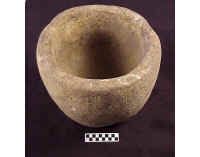
Image of groundstone artifact

No one really knows why charmstones were made or how they were used. Because charmstones often are finely shaped and well polished, and would have required a lot of work and time to make, many archaeologists believe they had some special purpose. It is possible that they had spiritual importance to the native peoples, since we sometimes find them buried with the dead.

Possibly a charmstone in a grave might have been a sign of the person's wealth and importance in the village. Some Native Americans and archaeologists believe that charmstones were used for hunting or fishing "magic," perhaps attached to nets to bring good luck to the hunt. They may have had practical purposes as well.

Picture of shell artifacts

The Emeryville people collected and traded shells with other groups to use for making beads and pendants. These ornaments must have been valuable to the native people, as they were not easy to obtain or make. Most of the shell beads and ornaments excavated in 1999 were found in graves. 

Beads were made from the shells of the olive snail (olivella), a small white or tan snail found in the bay and ocean.

The whole shell could be made into a bead by cutting or grinding off 1 end. Smaller circular or oval beads also could be cut from the sides of shells, and then perforated (drilled or punched) so they could be strung as necklaces or attached to clothing or other items.

Abalone shells also were used to make pendants- ornaments that could be hung around the neck or attached to clothing.

Abalone Shell Pendants

At Emeryville, only finished ornaments were found: there were no whole or broken abalone shells in the midden, so it is unlikely that the Emeryville people collected abalone as food or that they were able to get whole abalone shells.

Archaeologists believe that the people of Emeryville traded with the people who lived on the ocean coast to get abalone ornaments. Abalone ornaments of many different shapes, some with incised lines and dots, were found at Emeryville. Most of these were found in human graves. This tells us that these ornaments were especially valuable to the people, since they apparently did not use them in their everyday lives, but mostly used them to honor their dead.


How did the Native American people of Emeryville bury their dead?

We have no way of knowing what kinds of ceremonies the Emeryville people conducted, but we do know that they treated the dead reverently. Usually, when we find a grave in an archaeological site, we find only the skeleton, sometimes with tools and ornaments that were placed in the grave with the individual.

At Emeryville, many people were buried with shell ornaments and beads. These probably were strung or sewn onto headdresses or clothing, and were placed on the neck, head and body. Often the body also was covered with a powder or paste of red ochre, a red mineral pigment. The dead person's body was placed in a flexed position, with his knees drawn up to his chest. A pit 2 or 3 feet deep was excavated for the grave. We think that a fire sometimes was built in the pit before the person was placed in it. Probably after the fire went out, he or she was placed in the grave, usually face down or on his side, and the grave was filled with soil from the midden.

There may have been areas of the site that were used as cemeteries during different periods, but burials were present in many areas around the site. Archaeologists in 1999 noted that earlier graves often were disturbed prehistorically by the excavation of later graves. This suggests that most graves were not permanently marked. However, in 1 case, a group of 1 adult and several infant graves seems to have been marked by a pile of whale bones.


Was the Emeryville Shellmound a cemetery?

There were many graves in the Emeryville Shellmound. Some archaeologists and Native Americans believe that the site was mainly a special place to bury the dead and hold mourning ceremonies. Others believe that the people buried at Emeryville are the people who lived there, over the long history of the site. It is possible that the way the site was used changed over time. No one can know for sure.


Do archaeologists get to keep what they find?

Archaeologists do not keep what they find. When the analysis is complete and the archaeologist has tried to answer his or her own research questions about the site, archaeologists take archaeological collection to be stored in a museum or other special facilities. This is a way of making sure that the collection and information will be available for other researchers to study in the future. For most archaeologists, what is important is "not what we find, but what we find out."

In respect for the wishes of Ohlone descendants, human remains and the artifacts found with them at Emeryville were not placed in a museum, but were reburied in the ground, in a place where they would be safe from disturbance in the future.


Where happens to the artifacts and samples after they have been studied?

After analysis was completed, the artifacts and samples were taken to the Phoebe Apperson Hearst Museum of Anthropology at the University of California, Berkeley for permanent curation. There they will be carefully stored and preserved so that they can be studied by other archaeologists. There is always more to learn. Replicas of some of the artifacts will be displayed at the Community Room at the Bay Street Center in Emeryville.

Human skeletons that would have been destroyed by the cleanup or redevelopment of the site were excavated respectfully by archaeologists. Some Ohlone descendants prefer that no archaeological analysis be conducted on human remains or associated artifacts. The Native American observers at Emeryville decided that they did not want scientists to study the skeletons found at Emeryville. However, archaeologists were permitted to make casts - exact copies - of many of the artifacts that were found in graves, so that these could be studied. Human remains and associated artifacts were then reburied in a place that would be safe from future disturbance.