Over 1,800 artifacts were found in the Emeryville site in 1999. These included tools and ornaments of bone, ground or chipped stone, and shell. Although materials like wood, leather and plant fibers certainly were used at the site, these materials rot away in the ground, and seldom are found in archaeological sites. Usually, it is only the more durable materials that remain to be studied by archaeologists. Studies of the artifacts provided much information about how the native people lived and worked.
Bone tools were the most common artifacts found at the site. Archaeologists identified bone awls, needles, harpoon parts, whistles, beads and pendants.
Bone Tools: Bone Needle & Bone Whistle
Many bone artifacts are highly polished. They became smooth and shiny, either as part of their finishing, or through use. A few were decorated with fine incised geometric patterns. A bone tool specialist determined which animals the bone tools were made from and how the tools were made. Many bone tools from the Emeryville Shellmound were made from deer metapodials, one of the lower front leg bones. Also common were the wing bones of large birds.
A chipped stone tool specialist looked at the many projectile points (arrowheads) and other tools that were excavated from the site. Many of the chipped stone tools found at Emeryville were made of obsidian, a volcanic glass. Obsidian is not present naturally in the Bay Area. Much of the obsidian found at Emeryville came from Napa, over 40 miles away. People in Emeryville probably traded with other groups to get obsidian to make tools. Other stone tools were made from chert, a rock that probably could be collected from the Temescal Creek.
Early on, people at the site used large spear points to hunt. Much later, they used bows and arrows, which use much smaller stone points. The 2 examples of projectile points, shown below, were made by the earliest and latest inhabitants of the Emeryville Shellmound. Other cutting tools also were made of obsidian or chert.
Projectile Points: Chert Point & Obsidian Point
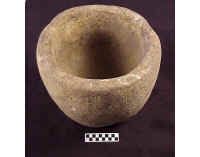
Archaeologists also found mortars, pestles, "charmstones" and stone pendants. These types of artifacts are classified as groundstone because they are made by grinding 1 stone against another. Some of the groundstone implements like the charmstones are very finely shaped, while others are not much more than stream cobbles that have been used for pounding. Mortars (stone bowls) and pestles (pounding or grinding stones) were used to grind grass seeds, acorns and buckeye nuts into flour, and probably to grind other foods as well.
No one really knows why charmstones were made or how they were used. Because charmstones often are finely shaped and well polished, and would have required a lot of work and time to make, many archaeologists believe they had some special purpose. It is possible that they had spiritual importance to the native peoples, since we sometimes find them buried with the dead.
Possibly a charmstone in a grave might have been a sign of the person's wealth and importance in the village. Some Native Americans and archaeologists believe that charmstones were used for hunting or fishing "magic," perhaps attached to nets to bring good luck to the hunt. They may have had practical purposes as well.
The Emeryville people collected and traded shells with other groups to use for making beads and pendants. These ornaments must have been valuable to the native people, as they were not easy to obtain or make. Most of the shell beads and ornaments excavated in 1999 were found in graves.
Beads were made from the shells of the olive snail (olivella), a small white or tan snail found in the bay and ocean.
The whole shell could be made into a bead by cutting or grinding off 1 end. Smaller circular or oval beads also could be cut from the sides of shells, and then perforated (drilled or punched) so they could be strung as necklaces or attached to clothing or other items.
Abalone shells also were used to make pendants- ornaments that could be hung around the neck or attached to clothing.
Abalone Shell Pendants
At Emeryville, only finished ornaments were found: there were no whole or broken abalone shells in the midden, so it is unlikely that the Emeryville people collected abalone as food or that they were able to get whole abalone shells.
Archaeologists believe that the people of Emeryville traded with the people who lived on the ocean coast to get abalone ornaments. Abalone ornaments of many different shapes, some with incised lines and dots, were found at Emeryville. Most of these were found in human graves. This tells us that these ornaments were especially valuable to the people, since they apparently did not use them in their everyday lives, but mostly used them to honor their dead.